The Sovereignty
Trade-Off

Global Governance and Sovereignty by Ayman & Akram

Our guiding questionHow much power should a nation give up to solve problems it cannot solve alone?

International organizations can help nations solve problems no single country can manage alone: pandemics, climate change, trade disputes. But every time a nation joins such an agreement, it also gives up a piece of its own decision-making power. This case file examines that trade-off: what is gained, what is given up, and where the line should be drawn.

Open the file ↓
Art. I · AnnexBefore we open the file
Tape 01 · Opening statement · Ayman & Akram
S

Definition 1

Sovereignty

auf Deutsch: Souveränität

A state's right to make its own decisions: its own laws, its own borders, its own money. Nobody above it gives orders.

For example: Germany decides its own taxes.

G

Definition 2

Global Governance

auf Deutsch: Weltordnungspolitik

Countries working together through shared rules and organizations, because some problems are too big for one nation.

For example: Almost every country on Earth agreeing to report new viruses.

The signatories

Four clubs nations join, and what it costs them.

Tap a logo to open its record.

Record · EU

European Union

A shared market, shared laws and for most members a shared currency.

What nations give up · EU law stands above national law. That makes it truly supranational, and Germany is part of it.

Member states

27

Sovereignty keptSovereignty shared

Our estimate of how much power members hand over.

Art. IIExhibit A · Documentary Evidence
II

The Case

A news report, summarised for the record.

23 January 2026

US officially leaves the World Health Organization

The US has officially withdrawn from the World Health Organization (WHO), leaving the UN agency without one of its biggest donors.

US President Donald Trump signed an executive order signalling the withdrawal a year ago, having criticised the organisation for being too “China-centric” during the Covid pandemic.

The US Department of Health and Human Services said it took the decision due to the WHO’s alleged “mishandling” of the pandemic, an inability to reform and political influence from member states. […]

SOURCE · Imogen Foulkes & Ottilie Mitchell, “US officially leaves World Health Organization,” BBC News, 23 January 2026.
Read the article on bbc.com→

The Evidence in Numbers

Fig. 1 · Funding
18%

of all WHO funding came from the United States, more than from any other country.

Fig. 2 · Top donor
$~490m
USA
Gates Found.
UK
Germany

in voluntary contributions (2020–2023), ahead of the Gates Foundation, the UK and Germany.

Fig. 3 · Consequence
2,371

jobs lost at the WHO by June 2026, almost a quarter of its 9,401 staff.
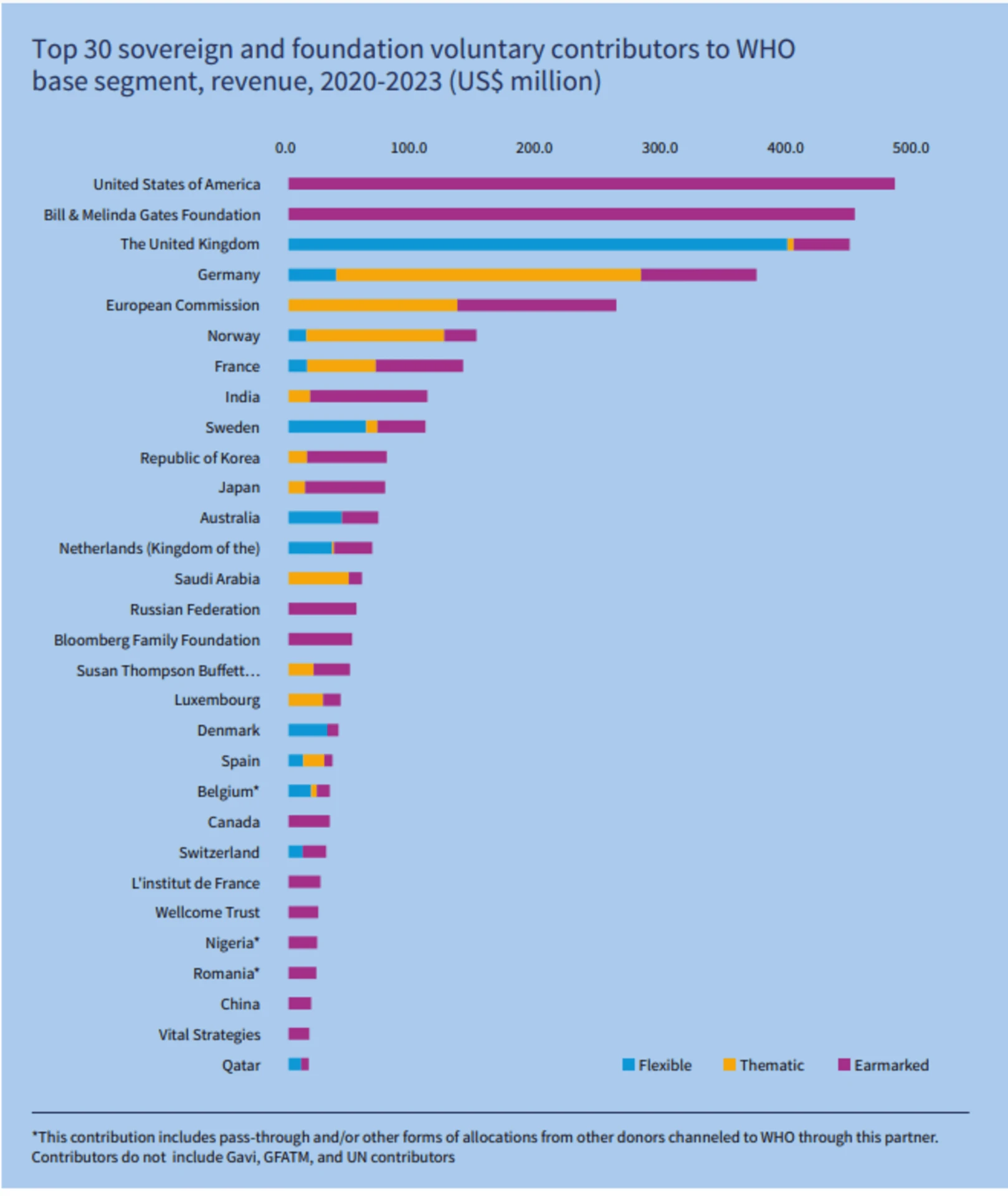
Bar chart of the top 30 voluntary contributors to the WHO, 2020–2023, with the United States in first place
Exhibit B · Top 30 voluntary contributors to the WHO, 2020–2023Tap to enlarge
SOURCES · WHO, contributor data 2020–2023; “WHO to lose nearly a quarter of its workforce – 2,000 jobs – due to US withdrawing funding,” The Guardian, 19 November 2025. theguardian.com
Art. IIIExhibit B · Audiovisual Evidence
III

How does the United Nations work?

A recording played before the court

Exhibit B · Tape 02 · TED-Ed

TED-Ed, played before the court. How the system was designed to work.

Art. IVInfographic · The Scales
IV

The Balance

What a nation places on the scale, and what it holds back. Tap a pan to weigh it.

SHAREDKEPT
Placed on the common scale

Powers nations share

  1. §1
    Emissions targets
    shared under the Paris Agreement
  2. §2
    Outbreak data
    reported to the international community
  3. §3
    Tariff rules
    followed as set by the WTO
  4. §4
    Human rights
    open to international review
Held back by the sovereign

Powers nations keep

  1. §1
    Ratification
    whether to ratify a treaty at all
  2. §2
    Domestic law
    and how it is enforced
  3. §3
    The exit door
    leaving an agreement unilaterally
  4. §4
    Force & borders
    military and border decisions
Art. VSchedule of Definitions
V

Glossary

Fifteen terms for the speaking test. Switch to drill mode to test yourself.

15 entries · alphabetised by importance
01
sovereignty
a state's right to govern itself without outside interference
02
to cede power
to give up authority to another body
03
binding agreement
a deal that legally obligates its signatories
04
non-binding
an agreement with no legal enforcement
05
to ratify a treaty
to formally approve it so it takes legal effect
06
supranational
having authority above individual national governments
07
nation-state
a sovereign country with a defined population and territory
08
multilateralism
cooperation among many states at once
09
to undermine
to weaken something gradually
10
self-determination
a people's right to decide their own political status
11
accountability
being answerable for one's decisions
12
enforcement mechanism
the means by which a rule is actually made to stick
13
to withdraw from
to formally leave an agreement or organization
14
global governance
the shared rules and institutions managing cross-border issues
15
trade-off
a balance between two competing goods
Art. VIPersonal Statement
VI

Our Position

The submissions of the presenters.

Our verdict
106 words · 5 sentences✓ Ready for the hearing
Ayman
Signature of counsel
Akram
Signature of counsel
Art. VIICross-Examination
VII

Now it's your turn. Scan to join.

Grab your phone, scan the code and enter the tribunal. Everyone plays live, against each other.

Open the live quiz →
tribunal-sovereign-showdown.lovable.app